Wall Street's Half-Finished Revolution

Wall Street transformed opportunities for women. Five years after its first female CEO, how much should you bet on another? We analyzed 2,167 careers to find out.
In late June, Marianne Lake left JPMorgan after twenty-five years: CEO of its consumer bank, and the last woman in the race to succeed Jamie Dimon. The same announcement named Doug Petno and Troy Rohrbaugh co-presidents, with thirty-million-dollar retention awards each. Everyone reached for the familiar explanation: the leaky pipeline, women draining away before the top. We traced it across 2,167 careers. It's true — just not where anyone points.
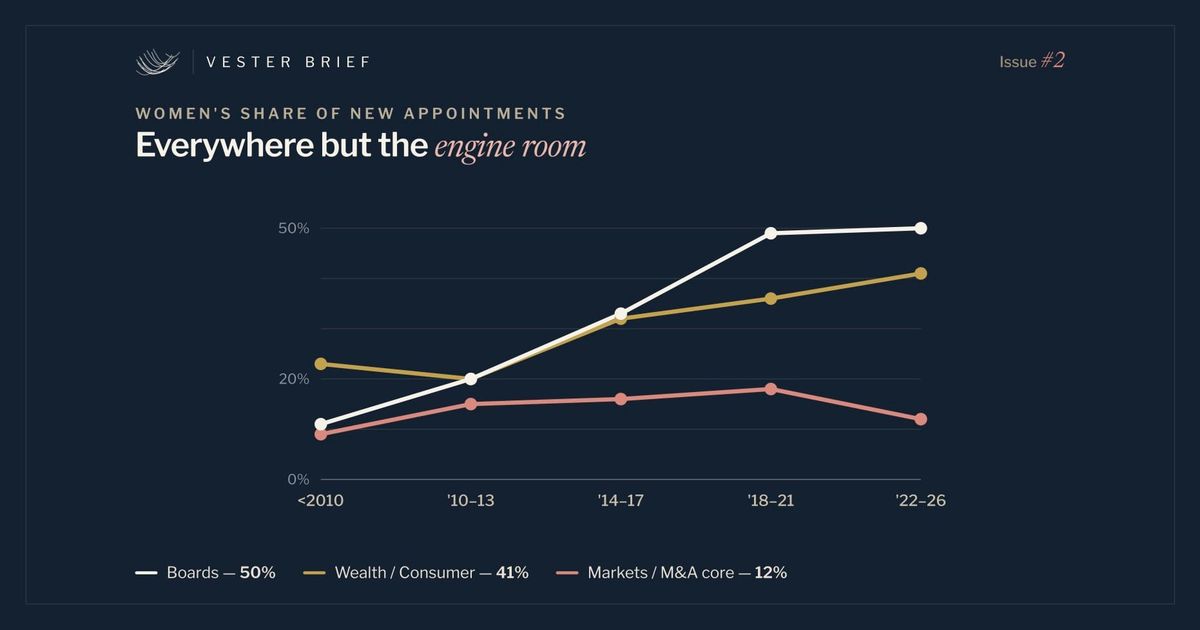
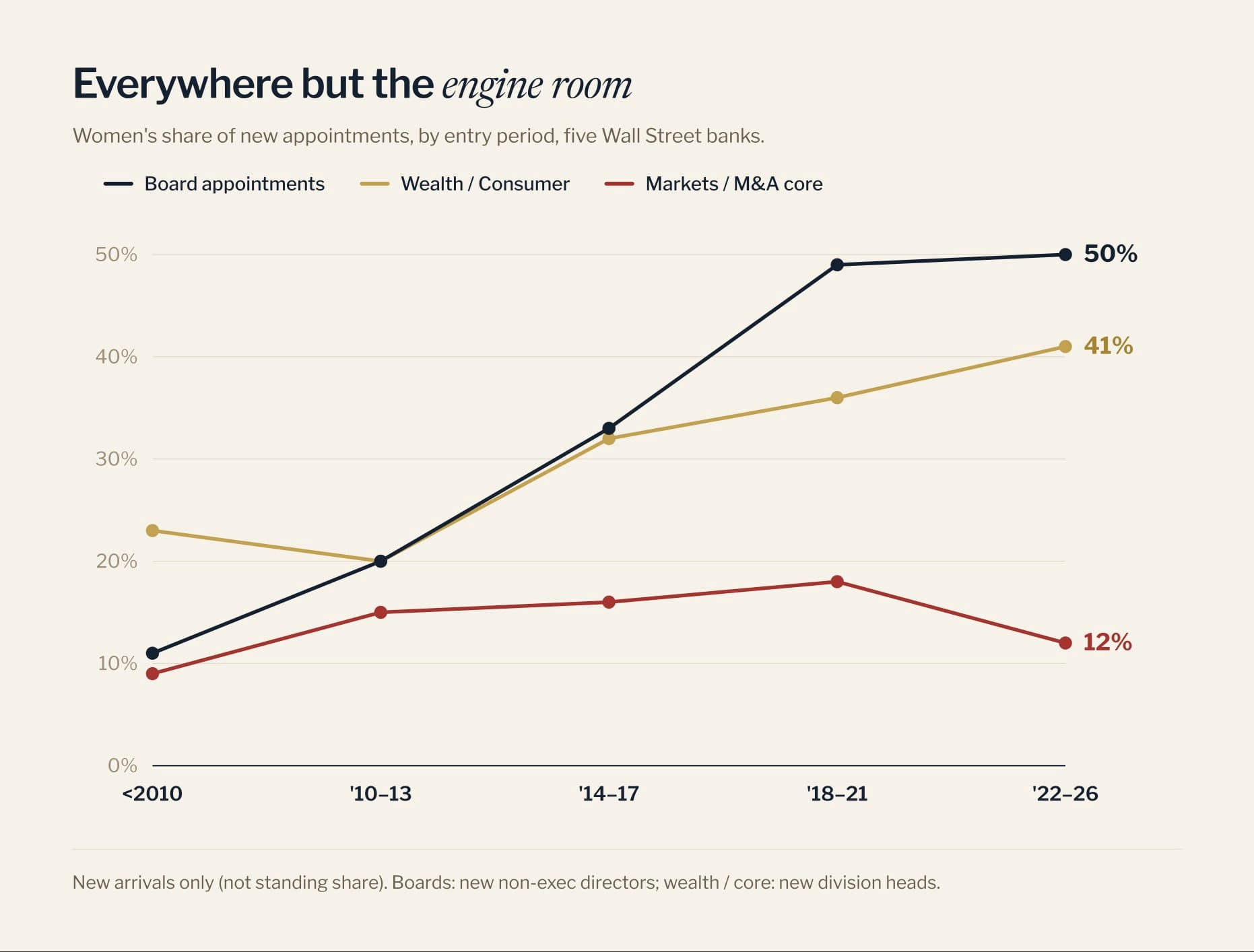
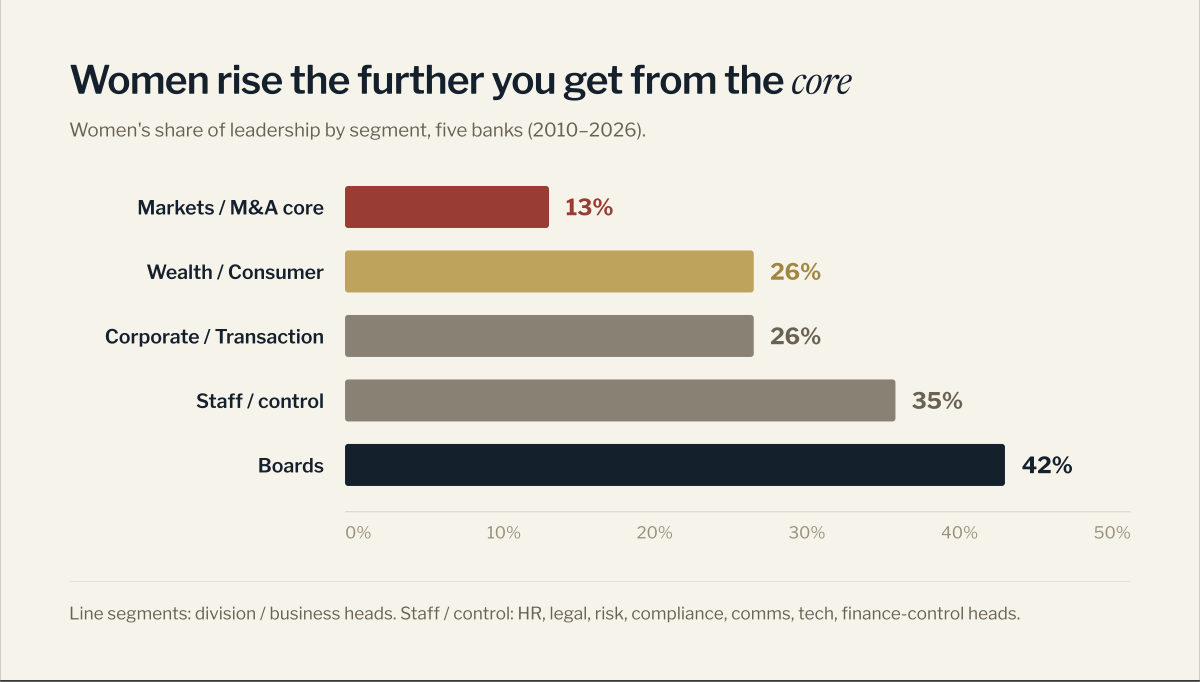
The revolution you can see. By almost every measure, women have arrived. On the five banks' boards, their share climbed from 14% in 2005 to 42% today; JPMorgan's board is six of eleven. In wealth and consumer, the same story: women went from 23% to 41% of new entrants. Even the control functions the bank runs on (risk, legal, compliance, HR) are 35% women among their leaders, a higher share than any business line. Mary Erdoes has run JPMorgan's asset-and-wealth arm since 2009, seventeen years on.
And beyond the bank. Past the firm itself, there is an avenue people rarely think to check. Nearly half of the 2,167 people who ran a piece of these banks since 2010 left to run something else: about a third as chief executives, more than half at public companies. The Federal Reserve, Fannie Mae, HSBC, the FTSE 100 all run on Wall Street alumni, and the women among them are unmistakable: Hammack to the Cleveland Fed, Almodovar to Fannie Mae, Liu to HSBC, Scherrer to a FTSE-100 CFO seat, Grace to a listed healthcare company. Wall Street makes the people who run everything else, and increasingly the women among them. Everywhere you look, no problem. You'd think it was solved.
The one room. There's a classic route to the corner office, and the mythology runs through the markets-and-M&A core: Solomon came up through Goldman's financing group, Pick through Morgan Stanley's equities, Rohrbaugh through JPMorgan's trading floor. It is also the one part of the bank the last fifteen years barely touched: women's share of new entrants crept from 9% before 2010 to an 18% peak around 2018–21, then slid back to 12%, the lowest of any segment, the gap to the rest of the firm only widening. At first glance, this looks like the culprit.
Except it's only the biggest door. Follow who actually reached the corner office, though, and the core turns out to be the largest single supplier of the bank's leaders: about 40% of them. The rest rose through wealth and consumer, the corporate bank, staff functions like finance and legal, or from outside altogether. And a wealth or consumer head reached the top at nearly the core's rate: 8% against 9%. James Gorman built Morgan Stanley's wealth-management arm before running the firm for over a decade; Brian Moynihan came up through Bank of America's consumer bank and its legal department; Jane Fraser, the only woman ever to run one of these banks, through Citi's consumer arm. She didn't reach the top by skipping the male core; she reached it the way most of them do — from somewhere else. There is more than one door to the corner office, and women stand in front of several of them. So why, five years on, is she still the only one?
Not at the top. Blame usually splits two ways: a ceiling near the corner office, or the long grind that wears women down before they reach it. The first we can test head-on. Across all 2,167 careers, it fails four times:
- Promoted internally less? No: equally (11% of women, 9% of men).
- Stuck longer? No: identical tenure, four years median.
- Exported out more? The opposite: women leave for outside C-suites less (18% vs 24%).
- Shunted to lesser roles? No: they land at public companies more often (68% vs 52%), not less.
Once a woman is running a piece of the bank, in any segment, her path from there matches the men's beside her: promoted to the C-suite at the same rate, holding her seat just as long. Equal outcomes at the top don't prove equal treatment — if the climb filters women harder, the survivors may simply be outperforming the bar. But the ceiling story needs them to fare worse from that seat, and they don't.
Appointed, not grown. It isn't a ceiling at the top, and it isn't one gatekept room. It's the pipeline itself. Women are just 17% of everyone who has run a major business at these banks since 2010, and about a fifth of those running one today. That is the pool from which future CEOs are drawn. The boards raced ahead because a board seat is appointed. You can add a qualified woman next quarter (the supply of board-ready women was never the constraint), and under two decades of diversity scorecards, the banks did: from 14% in 2005 to 42% today, bypassing the pipeline entirely. A division-head seat is grown. You can't appoint a markets veteran, or a consumer-bank chief; you keep her through a fifteen-year climb (analyst, associate, VP, MD, division head) and that climb still loses women at every rung.
Education moved: women are now 42% of MBAs (up from 30%), 30% of incoming analysts (up from 22%). But inside the bank the leak is brutal: in the markets track, roughly 30% of analysts are women, 6% of managing directors. By the division-head seat the loss has already happened, far below, consistent with Benson, Li and Shue's finding that women earn higher performance ratings but lower marks for "potential," the bias that bites hardest on discretionary mid-level promotions.
That's the real leaky pipeline. Not at the top, where outcomes are equal and the doors are several, but in the middle, from analyst to MD, where the climb toward running a business empties out. The banks learned to appoint women faster than to grow them.
Which way the bet moves from here is a question of mix. The feeder pool feminized fast and then stalled: from 14% in 2012 to a fifth by 2020, stuck there since as the core's intake slid back. Wealth and consumer, where women are best represented and still climbing (41% of the newest entrants), feeds the top about as reliably as the male core. A consumer-led decade would push the pool past that plateau, and the odds of a second female chief with it; a markets-led one, with the core still sliding toward 12%, keeps it stuck near a fifth.
The finding. Wall Street is a far more female place than it was fifteen years ago. Women now hold two in five board seats, a third of the control functions, and are unmistakable among the alumni it sends out to run the world.
It has learned to appoint female leaders. It hasn't yet learned to grow enough of its own.
Women are only about a fifth of the executives who run the banks' businesses. Until that changes, the odds of another female CEO remain low, not because women disappear at the top, but because too few ever reach the pool from which the top is drawn.
Our data locate the bottleneck. They do not, by themselves, explain why it forms.
The glass no longer looks like the ceiling.
It's the climb.
Methodology: Own analysis of the career histories of 2,167 division and business heads at JPMorgan Chase, Goldman Sachs, Morgan Stanley, Bank of America and Citigroup between 2010 and 2026. Executives were identified using a single classification rule applied consistently across banks and genders, with career paths reconstructed from employment histories, company disclosures and public announcements. Business segments were mapped to each bank's reported operating divisions. Results were tested against alternative role classifications and remained materially unchanged. Board composition was verified against company proxy statements, and all named appointments and career moves were cross-checked against company announcements and other public sources. MBA and analyst figures refer to industry-wide data, not the five banks specifically.