An Offer No Director Can Decline

The Sale of CNN and the Political Limits of Board Independence
Warner Bros. Discovery spent the past year as the most sought-after target in media. Netflix wanted the studios and the streaming platform. Paramount wanted everything, including CNN. Between December and February, the board had to decide while facing a hostile tender offer, a Delaware lawsuit and a proxy threat.
High-stakes decisions under pressure are precisely what independent boards are for, and WBD's board is independent by every formal test: twelve of thirteen directors. The consequences extended well beyond the boardroom. For shareholders, roughly $81 billion in equity value. For 35,500 employees, their owner. For CNN, a global newsroom whose sale the president had declared imperative, the question of who controls it.
The board rejected Paramount twice. Then Paramount added $2.5 billion, one dollar per share, and the board said yes. Whether that yes is worth anything is now being decided in Washington and in a California courtroom.
The dollar
Today the largest media deal of the decade is in deep freeze. On July 24, Paramount agreed in court not to close before the earlier of five days after a ruling on the merits or June 1, 2027. Two lawsuits, one brought by twelve state attorneys general, the other by the Writers Guild, seek to block a transaction federal antitrust authorities and Brussels have cleared and shareholders approved. The company is sold but not delivered. In the meantime, everyone waits: management cannot commit, employees cannot plan, the newsroom is losing people, and the shareholders' money sits behind a trial date. The waiting at least has a price tag: for every quarter of delay past September 30, the payout rises by up to $620 million, due if the deal ever closes.
How it got here is a board story. In December, WBD agreed to sell its studios and streaming business to Netflix for $72 billion in equity value, with the cable networks, CNN among them, spun off to shareholders. Paramount instead bid $30 per share in cash for the entire company: roughly $78 billion in equity value, $108 billion counting assumed debt. Rejection did not end the bid. Paramount sued in Delaware, threatened a proxy fight, and raised its offer by one dollar per share, $2.5 billion in total. In February the board declared it superior. Netflix walked.
The label
The decision was made by a board whose proxy classifies twelve of thirteen directors as independent.
The certification measures something real, but narrow. Nasdaq and NYSE define independence through relationships with management: employment, fees, audit ties, family on the payroll. Since 2025, Delaware has generally presumed exchange-classified independent directors to be disinterested unless specific evidence shows otherwise. The label now benefits from an explicit statutory presumption of disinterestedness.
Career data shows what the label leaves out.
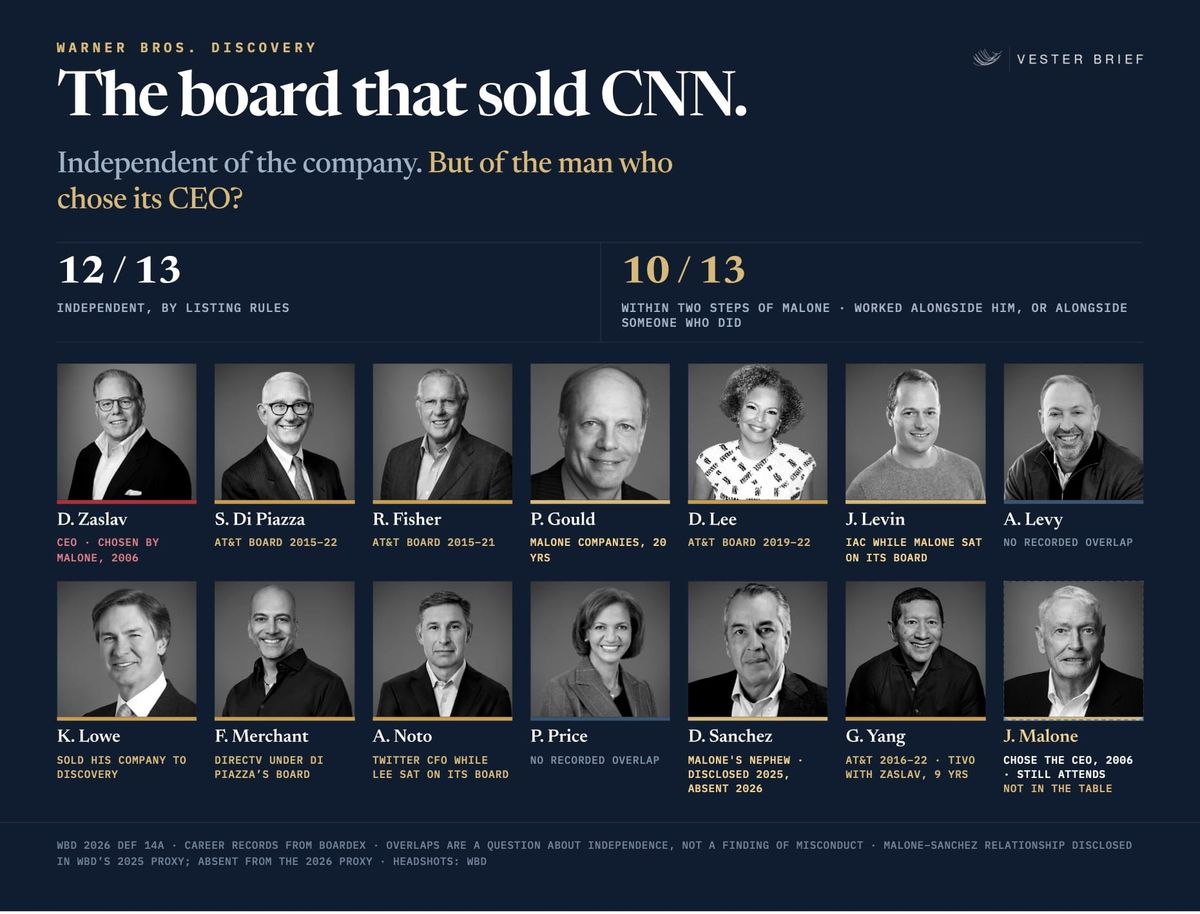
One independent director, Daniel Sanchez, is the nephew of John Malone, the cable pioneer who controlled Discovery through super-voting shares for two decades, chose David Zaslav as CEO in 2006, and continues to attend board meetings as non-voting Chair Emeritus. WBD disclosed the relationship in its 2025 proxy. The 2026 proxy, the document reporting this board's present independence, weighs the directors' business ties to Malone's Liberty companies and clears them. The word nephew appears nowhere in it. The explanation is formal: disclosure rules cover family relationships among directors and officers, and Malone left the board for the emeritus chair in 2025. The obligation followed his title out of the room. He did not. He continues to attend board meetings.
Paul Gould, who chairs the compensation committee, has sat on Malone vehicles for two decades; he and Sanchez share the Liberty Global and Liberty Latin America boardrooms today. Four directors, Samuel Di Piazza, Richard Fisher, Debra Lee and Geoffrey Yang, previously shared the boardroom of AT&T, the company that sold WarnerMedia to Discovery. Lee sat on the Twitter board that employed Anthony Noto as its CFO. Yang shared the TiVo boardroom with Zaslav for nine years and now helps set his pay. Even the 2025 refresh has roots: Joey Levin was an IAC finance executive while Malone sat on IAC's board.
In total: twelve of the sixty-six possible pairs of independent directors have shared an outside organization. Eight of the twelve independents are career-connected to a colleague. Ten of thirteen sitting directors have either worked alongside Malone in an outside organization or alongside someone who has. And every current independent director joined the board after Zaslav became CEO.
By the co-option measure used in the finance literature, this board is 100 percent co-opted. By the listing rules, it is 92 percent independent. Both numbers are correct, and both aim at the same worry: dependence on management. But they test different channels. The listing rules ask what a director currently receives from the company. Co-option asks whether the director joined during the incumbent CEO's tenure.
Co-option is not a cosmetic statistic, though it should be read precisely: the measure is tenure-based, counting directors who joined after the incumbent CEO took office, whether he handpicked them or they arrived through a merger. What it captures is era, not patronage; no one at this table predates the man they oversee. And in the data, that matters: boards appointed under an incumbent CEO monitor management less, pay rises, and dismissal after poor performance becomes rarer. Coles, Daniel and Naveen documented the pattern across US firms; Hwang and Kim showed the same for boards that are independent on paper but socially tied. What those studies measure is exactly what this deal tests: whether a label can substitute for distance.
One boundary is just as clean: the career records reviewed identify no institutional tie between any of these directors and the Ellison side of the table, neither the family's companies, Paramount, Skydance and Oracle, nor their financial backer RedBird. The board's entanglements run backward into the Malone world, not forward to the buyer. The career record supplies no evidence that friendship with the bidder explains the February reversal.
WBD's communications office did not respond to a pre-publication request for comment.
The regulator
The extra dollar is payable only if the deal closes. The merger itself transfers no broadcast licenses: WBD owns none. But Paramount operates 28 CBS stations under FCC license, and the foreign investment financing this acquisition has placed a separate ownership petition before the agency, approval Paramount says is not a condition to closing. The FCC is not a formal gate to the WBD sale. It is a source of leverage over the company buying CNN, and its recent record is not that of a neutral background actor.
Before the agency approved the Skydance takeover of Paramount in 2025, Paramount paid $16 million to settle the sitting president's lawsuit against 60 Minutes. The FCC then praised the new owners' commitments to change CBS News, including an ombudsman to review complaints of bias. The agency's sole Democratic commissioner accused it of using its leverage to pressure a news organization; the chairman denied any connection. Since then, ProPublica has reported that a commissioner accepted more than $12,000 in Paramount tickets after voting for the deal. And in December, as Paramount launched its bid for WBD, the FCC chairman watched the Kennedy Center Honors from a Paramount skybox with David Ellison. Comparable seats sold for $125,000. Who paid for the chairman's has not been established.
CNN would sit inside a company whose broadcast licenses remain subject to the FCC. The president has said it is "imperative" that CNN be sold, that he will probably be involved in the decision, and that the network spreads lies.
None of this proves a bargain. It proves that no WBD director can treat the FCC as an ordinary regulator.
The newsroom
For the people inside CNN, none of this is abstract. Since Netflix withdrew, staffers have described the mood to NBC News as shaken, and their reference point is concrete: they watched what new ownership meant at CBS, where 60 Minutes lost its executive producer and three of its best-known correspondents under the incoming leadership. The departures at CNN have already begun. Justice correspondent Paula Reid left for a competitor, citing the acquisition. Kara Swisher has vowed to leave if the deal closes. Anderson Cooper has reportedly told colleagues he will not work for the expected new management.
David Ellison promises that CNN will retain its editorial independence. CBS employees received the same assurance.
Are the departures something the directors must weigh? They destroy value, but the destruction lands elsewhere. This is an all-cash deal. Once it closes, every dollar the exodus destroys at CNN belongs to Paramount, not to WBD shareholders. The board does not need to count the newsroom's decay as lost shareholder value; the structure of the deal made it someone else's problem.
Where the departures do enter the board's math is nastier. They are unlikely to provide an exit from the agreement: merger agreements conventionally carve announcement effects out of the material adverse effect condition, and departures over the incoming owner are the textbook announcement effect. The company's own 10-K lists pendency-driven talent loss as a risk WBD bears. What the departures do instead is work as a ratchet. If the deal collapses, shareholders keep a CNN that the pendency has been hollowing out. Every consequential resignation can lower that fallback value, raising the cost of failure and increasing the pressure to preserve the transaction.
The departures do not argue for resistance. They compound the pressure to close.
The dilemma
Seen from inside the boardroom, the legal position is less conclusive than it appears: fiduciary duty did not say what the right answer was.
In February, Delaware law required the board to take the best value reasonably available. But weighing Paramount's $31-per-share offer against its regulatory and litigation risk was a judgment call, and the law left it to the board. The same is true now, during the pendency. Duty counsels protecting the closing; a collapse erases $2.5 billion and invites litigation. But duty does not say how far that goes. Does protecting the closing justify compromising journalistic independence at CNN? Delaying a controversial decision? The law has no formula. It narrows the choices without making them, and someone still has to choose.
Judgment calls are exactly what independence is for. The label exists to support confidence that close calls are decided on the merits, by people with nothing else in the room. That is the confidence this board's formal classification cannot supply on its own.
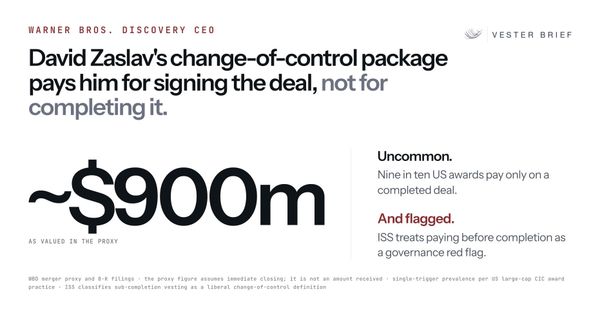
Start with the CEO. Co-option measures, by construction, how much of the board arrived on his watch: here, all of it. The board renegotiated his employment agreement in June 2025, three days after announcing the strategic review, and in January 2026, in the middle of the bidding war, granted him options and stock worth roughly $88 million. Whatever the CEO preferred, this is not a board built to discount it.
Then Malone. Ten of thirteen directors have worked alongside him, or alongside someone who has. One is his nephew. And Malone's view is not a mystery: $250,000 to the president's first inaugural fund, donations to his re-election committees, and, in 2021, the stated wish to see CNN "evolve back to the kind of journalism that it started with, and actually have journalists." His wish for a different CNN is on tape, four years before any bid existed.
And several directors carry political exposure of their own. Anthony Noto runs SoFi, a nationally chartered bank whose supervisors answer to this administration. Paula Price sits on the board of Accenture, one of the federal government's largest consulting contractors, and of Bristol Myers Squibb, which lives on FDA approvals and federal drug pricing. Noto and Geoffrey Yang share the board of Franklin Resources, an asset manager regulated by the SEC. Fazal Merchant is president of a software company that Alphabet, itself under federal antitrust scrutiny, acquired this spring. None of this is misconduct. It is the ordinary portfolio of the modern professional director. That is precisely the problem, because the mechanism is no longer hypothetical. In April 2025, an executive order suspended the security clearances of an entire cybersecurity firm because it employed one former official who had contradicted the president; he resigned to spare his colleagues. Other orders punished four law firms for the clients and causes of their partners. No WBD director has been threatened with anything. But a government that has already punished companies for the people attached to them does not need to make threats for the exposure to be felt in a boardroom. The independence rules ask whether directors depend on the company. Nobody asks whether they depend on the state.
The stakes sharpen the independence question. The vote determined who would own CNN after the president had declared its sale imperative. Malone was entitled to his view of the network, just as shareholders were entitled to prefer cash. Neither preference is itself evidence of a compromised process. The narrower question is whether the other twelve directors assessed them at sufficient distance. Their tenure, compensation, professional networks and political exposure all bear on that question; none answers it alone.
So the calls went the way they went: the whole company, CNN included, to the buyer the president favored. Perhaps thirteen people weighed value against certainty and decided on the merits. That cannot be ruled out. But formal independence cannot resolve the doubt, because every exposure identified here points in the same direction: a CEO whose equity the deal cashes out, a patriarch whose wish is on tape, an administration whose objective is declared.
The offer they could have declined
The outcome makes the law look more rigid than it is.
Delaware never forced this sale. Boards may refuse premium bids, and the controlling precedent carries the bidder's own name. In Paramount v. Time, 1989, Time's board rejected Paramount's premium tender offer, in part to protect what the court called "Time culture," the integrity of its journalism. The Delaware Supreme Court stood behind the refusal. Airgas, 2011, confirmed that a board may maintain its defenses against a bid it considers inadequate.
What the law constrains is the process once selling begins. Under the Revlon rule, named for Delaware's 1986 decision, directors selling for cash must secure the best value reasonably available to stockholders, assessed as a whole transaction, closing certainty included. It does not dictate which bid wins. And eBay v. Newmark, 2010, underscores the broader limit: directors of a for-profit corporation cannot subordinate stockholder value indefinitely to a public mission.
Read the timeline against that standard and the story splits in two. December created the sale process: the studios and streaming business went on the block, while CNN and the cable networks were to be spun off to shareholders, outside any buyer's reach. February brought CNN inside. By declaring the whole-company bid superior, the board moved the newsroom from the protected side of the transaction to the sold side. Revlon did not compel that outcome; the standard left room to weigh the closing risk of a deal carrying substantial regulatory and litigation risk. That risk is no longer hypothetical. It is a trial calendar stretching toward 2027.
What was sold
For shareholders, the board performed exceptionally: two rejections, $2.5 billion extracted, a $7.0 billion reverse termination fee, $45.72 billion guaranteed by Larry Ellison and an associated trust, a payout that ticks upward with delay. If the deal is bad economics, it is bad for markets, not for them: the concentration twelve states are in court calling illegal was the prize the buyer paid for, and charging fully for it was the board's job.
For stakeholders, the ledger is thinner. 35,500 employees have received a year of limbo and an owner to be determined by litigation; the writers' union is suing over what one fewer studio means for the people who sell it scripts.
Then the public good. Whether Paramount paid for CNN's cash flows or its political usefulness, the record cannot say, and the board did not need to know: its task was best value, whatever the buyer's motive. No one at that table was legally charged with protecting independent journalism. Once CNN moved inside the transaction, it became something a bidder could purchase.
Could true independence have changed the outcome? Perhaps not once the auction was underway. After the board declared Paramount's bid superior, the contractual and fiduciary constraints made resistance harder, though closing risk still left room for judgment.
The process was not imposed on the board. In June 2025 it announced a separation that kept CNN outside any buyer's reach. In October it widened the available options to include a transaction for the entire company. By February it had selected the whole-company offer. Independence does not dictate the answer inside a sale process. It shapes which process gets run, and what is placed inside it.
The comparison with 1989 is imperfect, and the imperfection is the point. In 1989 the cost of refusal fell principally on shareholders. No president had declared a preferred outcome while his administration held regulatory leverage over the companies involved.
The power to say no remains. The price of using it has changed.