The Billion-Dollar Signature

Paying Warner Bros. Discovery's chief executive for signing a deal rather than completing one is a remarkable board decision.
Chief executives in the media industry are well paid. Warner Bros. Discovery's board was willing to go beyond that and pay on top of it. Initially it wanted a corporate restructuring. In June 2025, before any bidder for WBD was public, it granted David Zaslav twenty million options struck near the year's low. Nearly all of them would be forfeited unless the company was broken up or sold within eighteen months. Then the auction began, and the board's preferred outcome narrowed from any restructuring to one particular transaction: a sale. In November, while bids were being solicited, it amended the agreement so that signing a sale would count, not merely completing one.
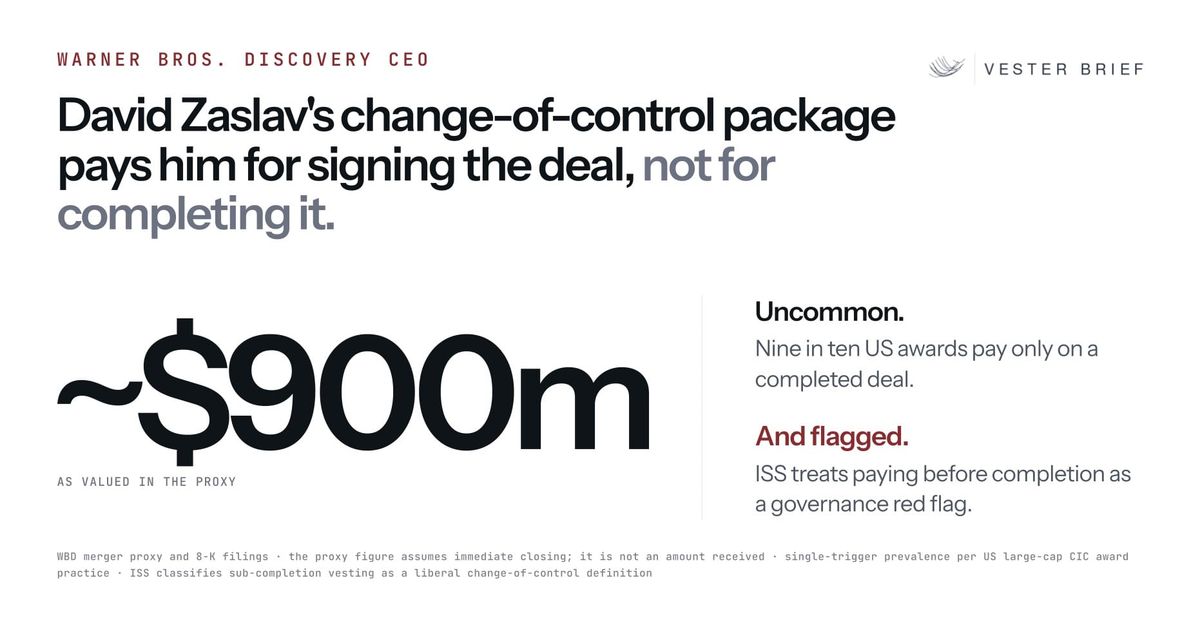
That is not the usual arrangement. Change-of-control terms normally turn on a transaction being completed, not on one being announced. ISS, which advises institutional investors how to vote, classifies vesting that triggers on anything short of completion as a liberal definition because it can produce a windfall when no change of control ever occurs. Around nine in ten equity awards at large US companies pay out only on a completed deal, and then only if the executive also loses the job. No comparable public case surfaced in which an existing grant was rescued from forfeiture by a signature alone.
Two further grants in January and an agreement in March to reimburse the excise tax completed the package. By the time the merger proxy appeared, Zaslav could read his own number in it: just under $900 million. The five named executives together came to $1.35 billion, of which his share was two thirds.
That figure is hypothetical, and by now old news. It assumes a takeover completed almost immediately. Disclosure rules require the company to value the package as though the merger had closed within days of the filing. The number was reported everywhere when the proxy appeared. What the arrangement does if the takeover never closes has received far less attention.
The obvious defence is that the auction added roughly $46 billion against the unaffected price, which puts the whole package under two percent of the value created. Attribution is the difficulty. The bidding was contested, two of the three performance hurdles on his options cleared only after the first bid became public, and the eventual buyer went hostile and sued the board in Delaware while it was still preferring Netflix. A price extracted by a bidder litigating against the board is not easily described as the board's achievement, or the chief executive's.
The board wanted this deal, and the chief executive, not entirely surprisingly, could not deliver it. Nobody can promise a regulator. The November amendment is easiest to understand from that constraint. If a chief executive cannot be paid for an outcome he does not control, pay him for the last step he does control.
The board may also have thought failure improbable.
Paramount's was an all-cash offer from a buyer whose ties to the current administration have been widely reported, against a Netflix structure that would probably have faced the hardest antitrust review available. A board that regarded federal approval as the binding constraint, and Paramount as the buyer best placed to obtain it, could reasonably assign a low probability to regulatory failure and write contracts accordingly. No filing establishes that reasoning, and two facts point the other way. Warner Bros. Discovery itself priced regulatory failure at $7 billion, and the principal challenge now comes from twelve state attorneys general, outside anything agreed in Washington.
The outcome the board paid for has not arrived. The parties have agreed not to close before either a merits ruling or June 2027, whichever comes first, so delay and failure are now the central scenarios rather than remote ones.
Neither appears to damage operations as much as intuition suggests. The most comprehensive study of failed takeovers follows 236 unsuccessful bids and asks what actually changed between announcement and failure. Across debt, employment, capital spending, research and assets it finds almost nothing, and no unusual chief executive turnover. What changes is the share price. A failed target drifts back towards its pre-auction valuation, cash targets retaining slightly more of the premium than stock targets. What does not reverse is the cost of attempting the transaction. The options written to secure it remain outstanding whatever a court decides.
For Zaslav, failure is not an especially adverse outcome. His signature lifted the forfeiture condition, leaving him with a conventional long-term equity package that vests through service and time. Nothing in the amendment makes that contingent on the transaction closing, or even on the merger agreement remaining in force. Some of it is already his and already saleable: the first instalment vested in June, and he sold more than $100 million of shares in the week after the merger agreement was signed. He now needs only to remain chief executive until 2030, or to be removed without cause before then, which accelerates the remainder.
The company is in a different position. A failed merger returns Warner Bros. Discovery to where it started, less the time spent pursuing it. The evidence that failed targets suffer little operating damage concerns what changed inside the company, not what the company might otherwise have done. The interval was spent inside a process rather than on a strategy, while the assets at the centre of the problem continue to decline whatever a court decides.
Paramount agreed to increase the purchase price the longer the transaction remains pending. That increase forms part of the consideration and is paid only at closing, so a blocked deal produces none of it. The $7 billion reverse termination fee is a claim rather than a receivable: Cigna negotiated almost $2 billion after the Anthem merger collapsed in 2017 and ultimately recovered nothing.
The larger cost is strategic. Until the agreement terminates, the merger covenants substantially constrain management's options. Two years under those constraints is not trivial for a company whose linear television business continues to shrink at double-digit rates.
If the transaction ultimately fails, the board will still have the chief executive it chose to reward for securing a sale. His contract runs through 2030, the year he turns seventy. The late sixties are normally when boards prepare succession rather than extend tenure. Retaining him will be expensive. Removing him without cause will be more expensive. Both outcomes follow from the same decision: to pay for a signature rather than a completed takeover.