Bonus, in Danish

CEOs are often rewarded for being in the right industry at the right time. When oil prices rise, oil CEOs become geniuses. When interest rates rise, bank CEOs suddenly do too. Bertrand and Mullainathan (2001) gave this a name: "pay for luck." They identified it as a central governance failure.
The post-2022 rate cycle was a textbook case. Central banks raised rates across the developed world; net interest margins widened; bank profits surged, regardless of whether anyone at any particular bank had caused it. Pay-for-luck logic predicts what came next: a compensation boom.
Not in Denmark.
If executive pay really followed performance, John Fisker should be one of Europe's highest-paid bankers. Over the past five years, Ringkjøbing Landbobank returned 178% to shareholders. In 2025 it earned 22.4% on equity with one of Europe's lowest cost-income ratios.
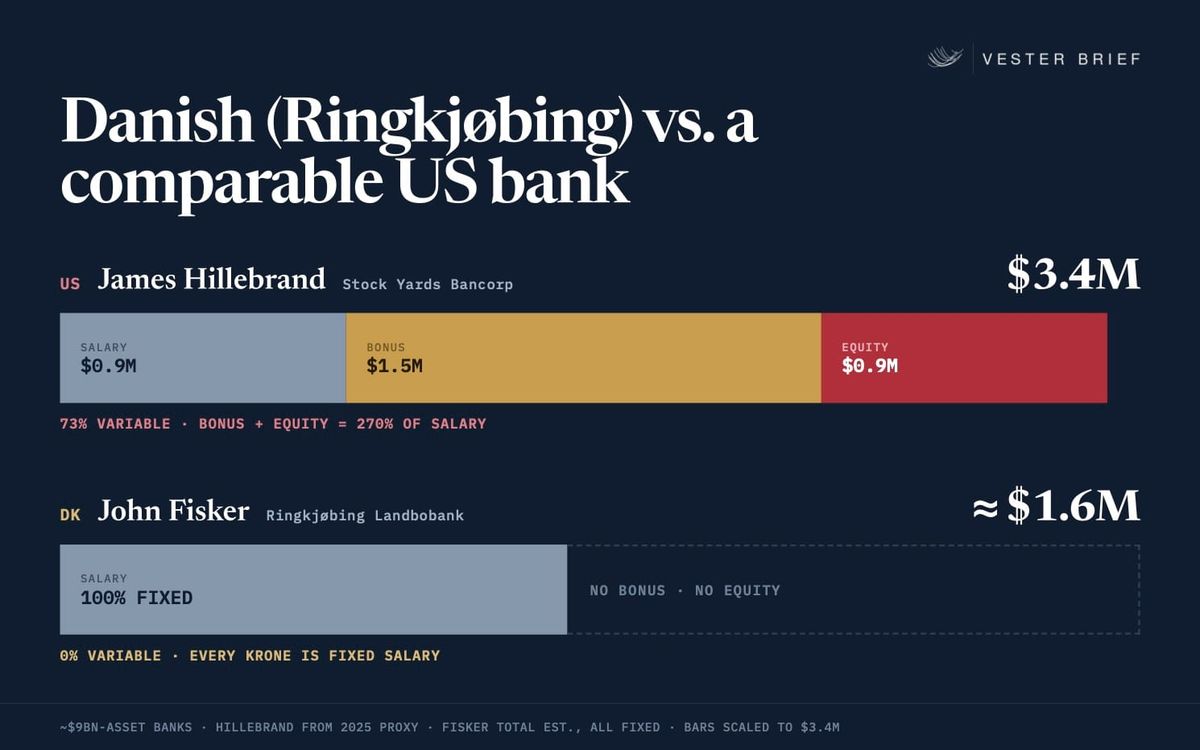
His bonus? Zero.
His total pay rose 8.4%. Every krone came through fixed salary.
Profits without pay. John Fisker isn't unusual. That's the surprising part. For several years, the country's banks posted record or near-record profits; driven, like banks across Europe, by the interest-rate cycle of 2022–2024, which expanded net interest margins and lifted returns on equity sector-wide. Yet their CEOs collected essentially the same salary as the year before. Earnings boomed. Executive pay barely moved. Higher bank profits typically feed higher executive pay. In Denmark, that relationship was surprisingly weak.
The chart below tells the story.
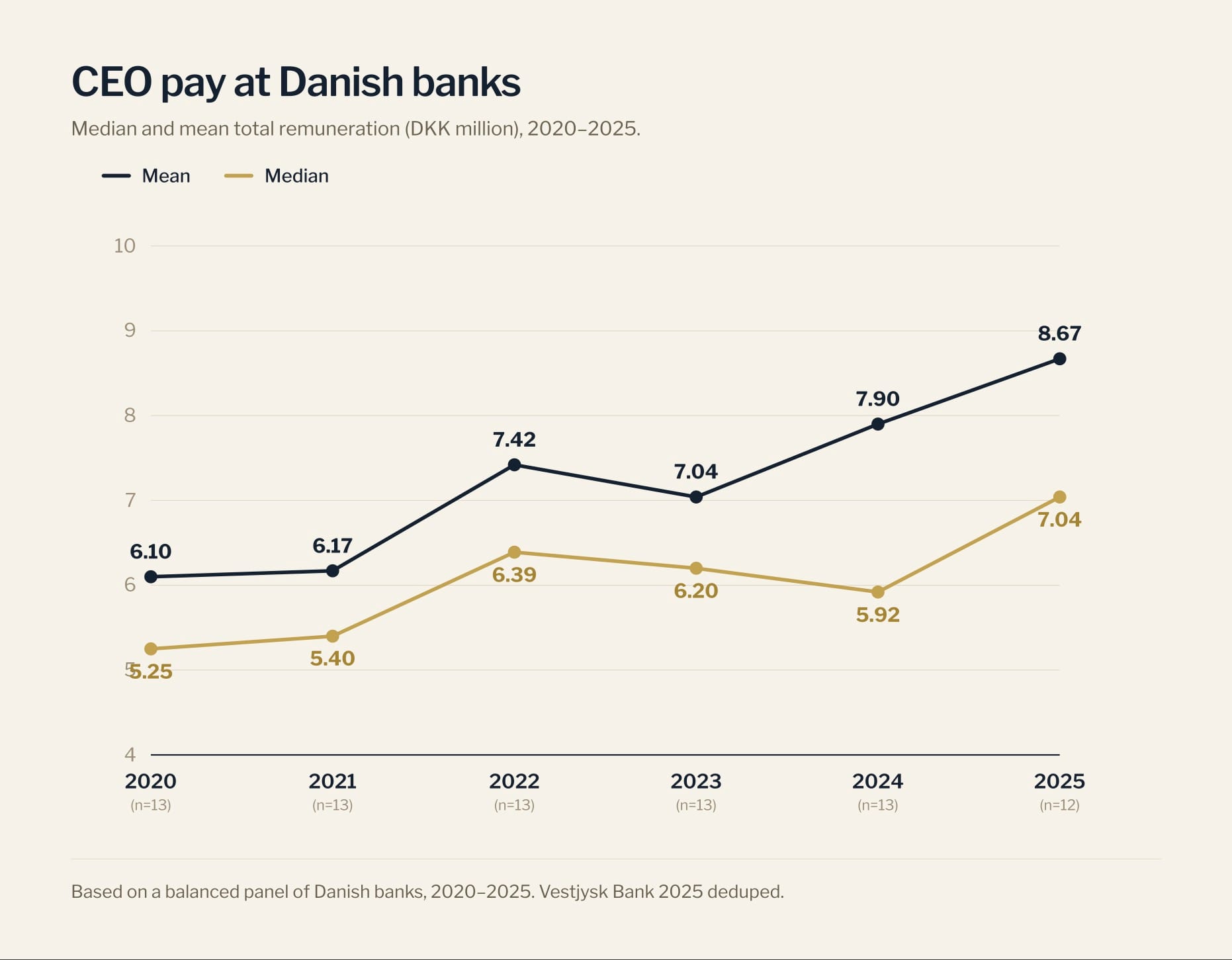
The Danish media captured the mood: "Ingen lønfest efter rekorder" — no pay bonanza after the records. That verdict still largely holds. The records came first; pay followed, cautiously, years later.
The chart reveals one striking pattern: boards responded to record profits by gradually increasing fixed salaries rather than paying bonuses. Bonuses reset. Base salary rarely does.
Three banks become one. One event dominated Denmark's banking sector last year: the merger of Arbejdernes Landsbank, Vestjysk Bank and Sydbank, creating AL Sydbank A/S, now Denmark's third-largest commercial bank.
Such transformational mergers are often accompanied by retention awards, special bonuses or equity grants as boards seek to reward the executive leading the integration.
Denmark again took a different path. Mark Luscombe, who became CEO of the combined bank, earned DKK 11.1 million in his first full year in the role, with no variable pay. Running a much larger institution translated into a higher fixed salary, not a more elaborate incentive package.
Why there are no bonuses. One explanation lies in ownership. Many Danish banks remain controlled by foundations, cooperatives or trade-union interests. Designing Wall Street-style bonus plans has never been central to that governance model.
This is the puzzle at the centre of Danish bank pay. Not that CEOs are underpaid — they are perhaps not, in any absolute sense. But that the connection between extraordinary performance and extraordinary pay, which forms the theoretical basis of most executive compensation design, is largely absent. Profits come. Bonuses do not follow. And yet the banks keep performing.
Economists have spent decades worrying that without bonuses managers won't try very hard. Danish banking appears to have misplaced the memo. Holmström showed that career concerns alone can substitute for explicit incentive contracts. Danish banking raises the possibility that boards rely more on reputation and intrinsic motivation than on bonuses.
Bank CEO pay in Europe is capped by regulation. Under the EU's Capital Requirements Directive (CRD IV), variable pay cannot exceed fixed salary without shareholder approval. For context, consider James Hillebrand, CEO of Stock Yards Bancorp: a US community bank of roughly comparable size to Ringkjøbing Landbobank (~$9 billion in assets). In 2025 he earned $3.4 million in total: a base salary of $875,000, a short-term bonus of $1.5 million (170% of base), and long-term equity awards of $875,000 (100% of base). Variable pay: 270% of his fixed salary — a structure prohibited by European regulation.
The EU cap of 100% was designed to prevent exactly that structure from taking hold in European banking. Even so, two 2025 Danish cases stand out, and both remain well within the ceiling. Kim Fournais at Saxo Bank earned DKK 20.7 million (up 18%): DKK 12.2 million in fixed salary plus DKK 8.5 million in short-term variable pay — 69% of his base — and no long-term incentive plan. Saxo is founder-controlled, globally oriented, and primarily a trading and investment bank rather than a traditional retail lender. Carsten Egeriis at Danske Bank earned DKK 24.6 million (up 11%): DKK 19.3 million in fixed remuneration and DKK 5.3 million in variable pay, spanning short-term cash, short-term shares, and long-term shares, equal to 27% of his fixed salary, rebuilding a bank that paid €2 billion in fines for the largest money laundering scandal in Nordic history.
Both are exceptions. The puzzle is Ringkjøbing Landbobank, and the 25 other Danish bank CEOs who earned no variable pay in 2025 despite sitting on some of the most profitable balance sheets in European banking.
As for luck. Danish bank CEOs had plenty of luck: two years of record profits driven by macroeconomic tailwinds they did not create. What Bertrand and Mullainathan predicted would follow did not. No bonus surge. No pay for luck in the conventional sense. Boards raised fixed salaries, slowly and permanently. Shareholders kept the windfall.
Perhaps the Danish model rests on a simpler premise: hire capable managers, pay them well, and rely on vigilant boards — not increasingly elaborate incentive contracts.
That proposition deserves to be tested.
Methodology: 29 Danish banks with published 2020-25 vederlagsrapporter. 5.7% is the median YoY change for banks present in both years. Trend uses a 13-bank balanced panel. Pay from vederlagsrapporter filed with Finanstilsynet; includes fixed salary, bonus, pension, and benefits. ArbejdernesLandsbank and VestjyskBank 2025 excluded; represented by the AL Sydbank row.